
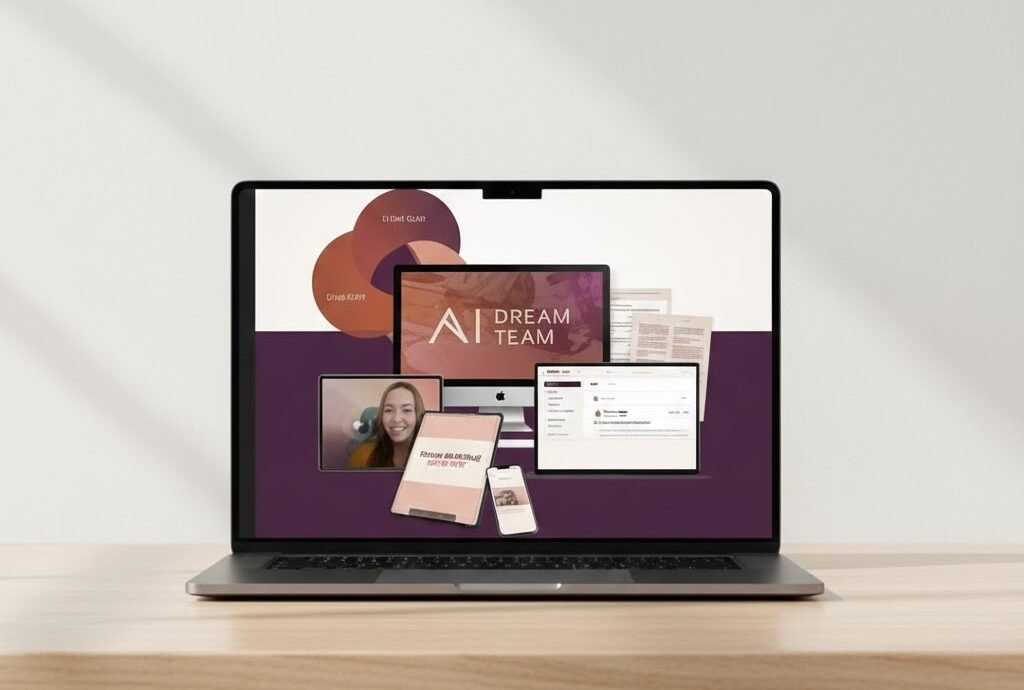
Natalie MacNeil – AI Dream Team: Building a Smart, Scalable Business with AI Collaboration
Introduction
The rise of artificial intelligence has completely reshaped how modern businesses operate, scale, and compete. Entrepreneurs are no longer asking if they should use AI—but how to use it effectively. This is where Natalie MacNeil – AI Dream Team emerges as a powerful concept, representing a strategic approach to assembling intelligent AI tools and systems that function like a high-performance digital team.
Rather than relying on one AI solution for everything, this framework emphasizes collaboration—multiple AI roles working together to streamline workflows, enhance decision-making, and unlock creative potential. The AI Dream Team philosophy is not about replacing humans, but about amplifying human vision through automation, intelligence, and execution speed.
In this guide, we’ll explore the foundation, structure, benefits, and real-world applications of this approach, showing how entrepreneurs and creators can leverage AI as a scalable business partner rather than a single tool.
Understanding the AI Dream Team Concept
What Is an AI Dream Team?
An AI Dream Team is a curated ecosystem of artificial intelligence tools, models, and automations—each assigned a specific role, much like a human team. Instead of one general AI handling everything, different systems focus on:
-
Strategy and planning
-
Content creation
-
Marketing and analytics
-
Customer engagement
-
Operations and automation
The Natalie MacNeil – AI Dream Team approach centers on orchestration: ensuring each AI component works in harmony to support business goals.
Why a Team-Based AI Approach Works Better
Single AI tools often struggle with context switching. A team-based structure offers:
-
Higher efficiency through specialization
-
Reduced cognitive overload
-
Faster execution across multiple tasks
-
Consistent quality across outputs
This method mirrors how successful businesses scale with people—only now, the workforce includes intelligent systems.
The Core Pillars of the Natalie MacNeil AI Framework
1. Strategic AI Leadership
At the top of the AI Dream Team sits strategic intelligence. This layer focuses on:
-
Business planning
-
Market research
-
Competitive analysis
-
Decision modeling
Rather than reacting to trends, AI assists in predicting outcomes and guiding long-term strategy.
2. Creative AI Systems
Creativity remains essential in branding and growth. Creative AI roles support:
-
Content ideation
-
Copywriting and storytelling
-
Visual design prompts
-
Product naming and messaging
The AI Dream Team doesn’t replace creativity—it accelerates it.
3. Marketing & Growth Automation
Marketing is one of the biggest beneficiaries of AI collaboration. Growth-focused AI roles handle:
-
Funnel optimization
-
Email sequence personalization
-
Ad copy testing
-
SEO research and optimization
This ensures consistent messaging while adapting quickly to audience behavior.
4. Operations & Workflow AI
Behind the scenes, operational AI manages:
-
Task automation
-
Scheduling and reminders
-
SOP creation
-
Data organization
This operational layer allows founders to focus on vision rather than logistics.
5. Customer Experience Intelligence
Customer-focused AI enhances:
-
Support responses
-
Personalization
-
Feedback analysis
-
Community engagement
This improves satisfaction while reducing response time and manual effort.
How the AI Dream Team Transforms Business Models
From Solo Founder to Scalable Operator
Many entrepreneurs hit a ceiling when relying solely on personal time and effort. The Natalie MacNeil – AI Dream Team model breaks this limitation by creating leverage. Tasks that once required a full staff can now be managed through AI collaboration.
Speed Without Burnout
With AI handling repetitive and analytical tasks:
-
Execution speeds increase
-
Decision fatigue decreases
-
Creative energy is preserved
This balance allows businesses to grow sustainably rather than chaotically.
Real-World Applications of the AI Dream Team
Content Creators & Educators
AI roles assist with:
-
Course creation
-
Lesson structuring
-
Script writing
-
Content repurposing
This enables creators to scale their knowledge without sacrificing quality.
Coaches & Consultants
AI systems support:
-
Client onboarding
-
Personalized recommendations
-
Progress tracking
-
Follow-up automation
The result is a more professional and scalable service experience.
E-Commerce & Digital Products
AI Dream Teams help manage:
-
Product descriptions
-
Customer queries
-
Inventory forecasting
-
Sales analytics
This improves efficiency and profitability.
Startups & SaaS Businesses
AI collaboration accelerates:
-
MVP development
-
User research
-
Feature prioritization
-
Support ticket handling
Startups gain enterprise-level intelligence without enterprise-level costs.
Designing Your Own AI Dream Team
Step 1: Identify Bottlenecks
Start by listing tasks that consume time, energy, or attention. These are ideal candidates for AI roles.
Step 2: Assign AI Roles
Instead of “one AI,” assign functions such as:
-
AI strategist
-
AI writer
-
AI marketer
-
AI analyst
-
AI operations manager
This mirrors the Natalie MacNeil – AI Dream Team philosophy of role clarity.
Step 3: Create Workflow Connections
Ensure AI outputs feed into each other. For example:
-
Strategy AI informs content AI
-
Content AI feeds marketing AI
-
Marketing AI provides data to analytics AI
This creates a loop of continuous improvement.
Step 4: Human Oversight & Direction
AI works best with clear guidance. Humans remain responsible for:
-
Vision
-
Ethics
-
Final decision-making
-
Emotional intelligence
The goal is partnership, not dependency.
Common Mistakes to Avoid
Over-Automation Without Strategy
Using AI everywhere without direction leads to noise, not results. Strategy must come first.
Tool Overload
More tools don’t mean better outcomes. The AI Dream Team focuses on alignment, not quantity.
Ignoring Data Quality
AI outputs are only as good as the inputs. Clean data and clear prompts are essential.
Lack of Review Systems
Regular audits ensure AI continues to align with brand voice and goals.
Measuring Success with AI Collaboration
Key indicators to track:
-
Time saved per task
-
Output consistency
-
Conversion improvements
-
Customer satisfaction
-
Revenue per employee (or per founder)
When these metrics improve, your AI Dream Team is working.
The Future of AI-Powered Teams
As AI models become more specialized, the concept of collaborative intelligence will dominate. Businesses will move from “using AI tools” to leading AI teams.
The Natalie MacNeil – AI Dream Team framework reflects this shift—positioning entrepreneurs not as operators, but as orchestrators of intelligence.
Those who master AI collaboration early will gain a lasting competitive advantage.
Conclusion
The future of business belongs to those who understand leverage—and few forms of leverage are as powerful as intelligent collaboration. Natalie MacNeil – AI Dream Team represents a new way of thinking: one where AI is not a shortcut, but a structured system supporting growth, creativity, and impact.
By assigning roles, building workflows, and maintaining human leadership, entrepreneurs can scale faster, work smarter, and create businesses that are both profitable and sustainable. The dream team is no longer just human—it’s intelligent, adaptive, and always evolving.



Reviews
There are no reviews yet.