
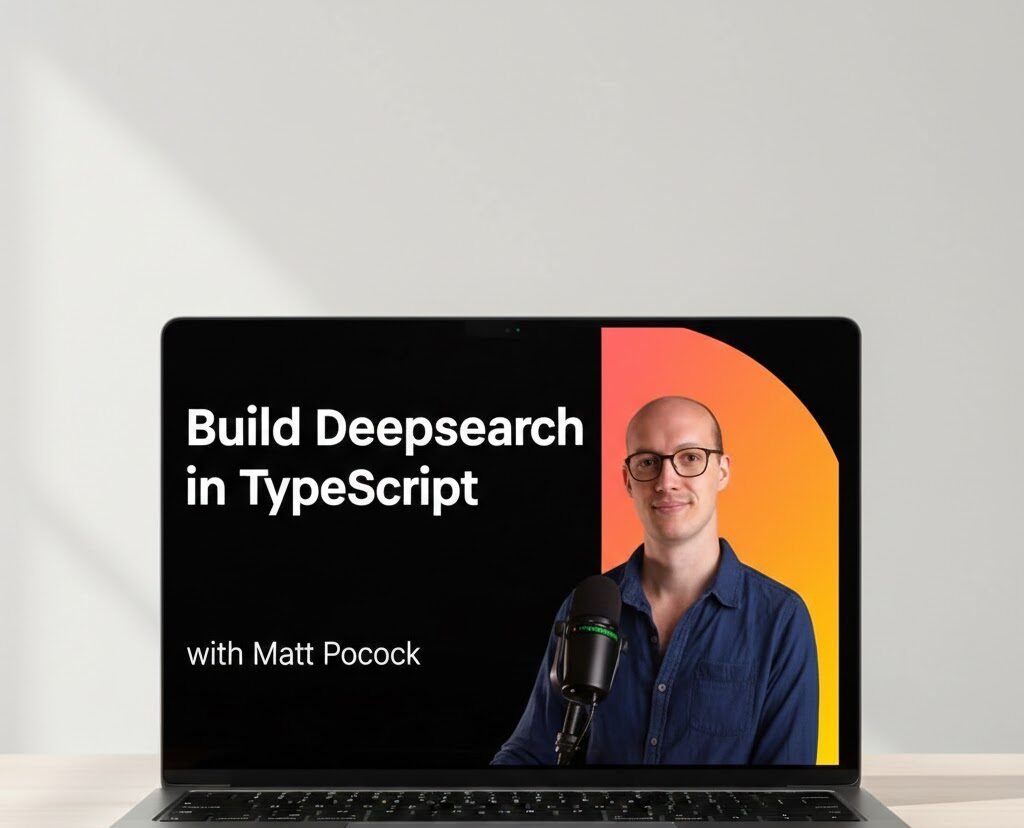
Matt Pocock (AIhero) – Build DeepSearch in TypeScript: The Complete Developer’s Guide
Introduction
Modern applications demand intelligent search capabilities that go far beyond simple keyword matching. Developers are now building contextual, semantic, and AI-powered search engines that understand intent, structure, and relationships. That’s exactly where Matt Pocock (AIhero) – Build DeepSearch in TypeScript becomes a powerful reference point.
This concept represents more than just a coding tutorial—it reflects a structured approach to building scalable, type-safe, AI-enhanced search systems using TypeScript. By combining strong type systems, generics, inference patterns, and AI-driven ranking logic, developers can construct DeepSearch architectures that are robust, maintainable, and production-ready.
In this in-depth guide, we’ll explore how to design and implement DeepSearch systems in TypeScript, inspired by the principles behind Matt Pocock (AIhero) – Build DeepSearch in TypeScript, and how to optimize them for performance, scalability, and real-world usage.
Understanding DeepSearch in Modern Applications
What Is DeepSearch?
DeepSearch goes beyond traditional search algorithms. Instead of matching static keywords, it:
-
Understands structured data
-
Leverages semantic meaning
-
Supports nested object traversal
-
Applies ranking logic
-
Integrates AI models
-
Utilizes advanced TypeScript type inference
The idea behind Build DeepSearch in TypeScript is to merge intelligent querying with strict type safety.
Why TypeScript Is Ideal for DeepSearch Systems
TypeScript offers unique advantages when building complex search architectures:
1. Static Type Safety
TypeScript prevents runtime surprises. When building a DeepSearch engine, you often deal with:
-
Nested data objects
-
Optional properties
-
Generic constraints
-
Dynamic filtering
Strong typing ensures your search logic aligns perfectly with your data schema.
2. Advanced Generics & Utility Types
DeepSearch often requires dynamic traversal of deeply nested structures. With TypeScript generics, you can:
-
Infer keys dynamically
-
Create recursive type utilities
-
Ensure safe property access
-
Build dynamic query builders
3. Scalability & Maintainability
Large-scale search systems can quickly become messy. TypeScript’s structure keeps your codebase maintainable as your DeepSearch engine evolves.
This is one of the reasons Matt Pocock (AIhero) – Build DeepSearch in TypeScript resonates strongly with developers who prioritize clean architecture.
Core Architecture of a DeepSearch Engine
To implement DeepSearch effectively, you need a layered architecture:
1. Data Indexing Layer
Before searching, data must be indexed.
-
Normalize incoming data
-
Flatten nested objects
-
Extract searchable fields
-
Store metadata for ranking
This layer determines performance and relevance.
2. Query Parsing Layer
DeepSearch requires structured queries.
-
Support partial matching
-
Support nested key access
-
Allow logical operators (AND, OR, NOT)
-
Enable semantic expansion
TypeScript interfaces ensure your query structure remains consistent.
3. Matching & Traversal Engine
This is the heart of DeepSearch.
-
Recursive traversal
-
Key-path resolution
-
Type-safe property access
-
Deep object filtering
Using mapped types and conditional types, you can enforce compile-time guarantees.
4. Ranking & Scoring System
To move beyond basic filtering:
-
Assign weights to fields
-
Calculate relevance scores
-
Use cosine similarity (for embeddings)
-
Rank results by priority
This transforms your DeepSearch into an intelligent system.
Building DeepSearch with TypeScript: Step-by-Step Strategy
Inspired by the methodology behind Build DeepSearch in TypeScript, here’s how you approach implementation.
Step 1: Define Strong Data Models
Start with well-defined interfaces.
-
User profiles
-
Articles
-
Products
-
Metadata objects
Use union types and discriminated unions where appropriate.
Step 2: Create Recursive Key Utilities
DeepSearch needs nested key traversal.
Use advanced TypeScript techniques:
-
Recursive mapped types
-
Keyof constraints
-
Template literal types
-
Indexed access types
These tools allow dynamic deep property resolution safely.
Step 3: Build a Generic Search Function
Your search function should:
-
Accept generic data types
-
Infer searchable keys
-
Filter deeply nested values
-
Return typed results
The key is preserving type inference across operations.
Step 4: Optimize for Performance
DeepSearch can become expensive computationally. Optimize by:
-
Memoization
-
Pre-indexing
-
Avoiding repeated recursion
-
Lazy evaluation
Efficiency is critical in production environments.
Integrating AI into DeepSearch
The phrase Matt Pocock (AIhero) implies AI-driven development. DeepSearch becomes far more powerful when paired with AI features:
Semantic Search with Embeddings
Instead of exact string matching:
-
Convert text into embeddings
-
Compare vector similarity
-
Rank results by semantic closeness
Hybrid Search (Keyword + Semantic)
Combine:
-
Traditional filtering
-
Vector search
-
Rule-based boosting
This hybrid approach yields highly accurate results.
AI-Powered Suggestions
Add:
-
Autocomplete predictions
-
Context-aware suggestions
-
Intelligent ranking adjustments
This is how DeepSearch evolves from filtering into intelligent discovery.
Real-World Use Cases
1. Developer Documentation Platforms
DeepSearch can:
-
Search across nested markdown structures
-
Match code snippets
-
Rank by relevance
2. E-commerce Platforms
-
Filter products by deeply nested attributes
-
Support dynamic search facets
-
Combine semantic recommendations
3. Knowledge Bases
-
Traverse nested categories
-
Provide contextual search
-
Suggest related documents
4. SaaS Dashboards
-
Search deeply structured JSON responses
-
Filter large datasets
-
Provide real-time updates
The methodology reflected in Build DeepSearch in TypeScript applies across industries.
Common Mistakes When Building DeepSearch
Even experienced developers can struggle with:
1. Ignoring Type Safety
Using any defeats the purpose of TypeScript. Maintain strict typing.
2. Overcomplicating Generics
Complex type definitions should remain readable. Avoid unnecessary abstraction.
3. Poor Indexing Strategy
Without proper indexing, search performance degrades dramatically.
4. No Benchmarking
Measure:
-
Query time
-
Memory usage
-
Ranking accuracy
Optimization should be data-driven.
Performance Best Practices
To make DeepSearch production-ready:
-
Use Web Workers for heavy computation
-
Cache frequent queries
-
Batch processing for vector comparisons
-
Paginate large results
-
Avoid deep cloning of objects
Performance engineering separates prototypes from scalable solutions.
Testing DeepSearch Systems
When implementing Matt Pocock (AIhero) – Build DeepSearch in TypeScript, testing is essential.
Unit Testing
-
Validate recursive traversal
-
Test type inference
-
Confirm edge cases
Integration Testing
-
Test full query flow
-
Validate ranking logic
-
Benchmark real datasets
Type-Level Testing
Use tools like:
-
Type assertions
-
Conditional type tests
-
Utility test helpers
Type-level correctness ensures long-term reliability.
Scaling DeepSearch for Enterprise Applications
As data grows:
-
Move indexing to server-side
-
Implement distributed search
-
Use vector databases
-
Add caching layers
-
Introduce sharding
Enterprise-ready DeepSearch requires infrastructure planning.
The Developer Mindset Behind DeepSearch
The philosophy embedded in Matt Pocock (AIhero) – Build DeepSearch in TypeScript reflects:
-
Precision over shortcuts
-
Type safety over guesswork
-
Scalability over hacks
-
Clarity over complexity
It’s not just about writing code—it’s about engineering durable systems.
Future of DeepSearch in TypeScript
The future includes:
-
AI-native search systems
-
Real-time vector embeddings
-
Edge-computed search engines
-
TypeScript-first AI frameworks
-
Fully typed AI pipelines
As AI continues evolving, DeepSearch will increasingly combine structured programming with machine learning capabilities.
Conclusion
Building intelligent search systems requires more than simple filtering—it demands architecture, type safety, performance engineering, and AI integration. The approach reflected in Matt Pocock (AIhero) – Build DeepSearch in TypeScript demonstrates how modern TypeScript capabilities empower developers to create scalable, efficient, and intelligent search engines.
By combining recursive types, generics, semantic ranking, indexing strategies, and AI enhancements, developers can build DeepSearch systems that are both elegant and powerful.
If you’re serious about mastering TypeScript architecture and AI-powered search design, building DeepSearch is one of the most valuable projects you can undertake.




Reviews
There are no reviews yet.